
Website, CRM and ERP in one platform: how we digitalised Detaljtryck
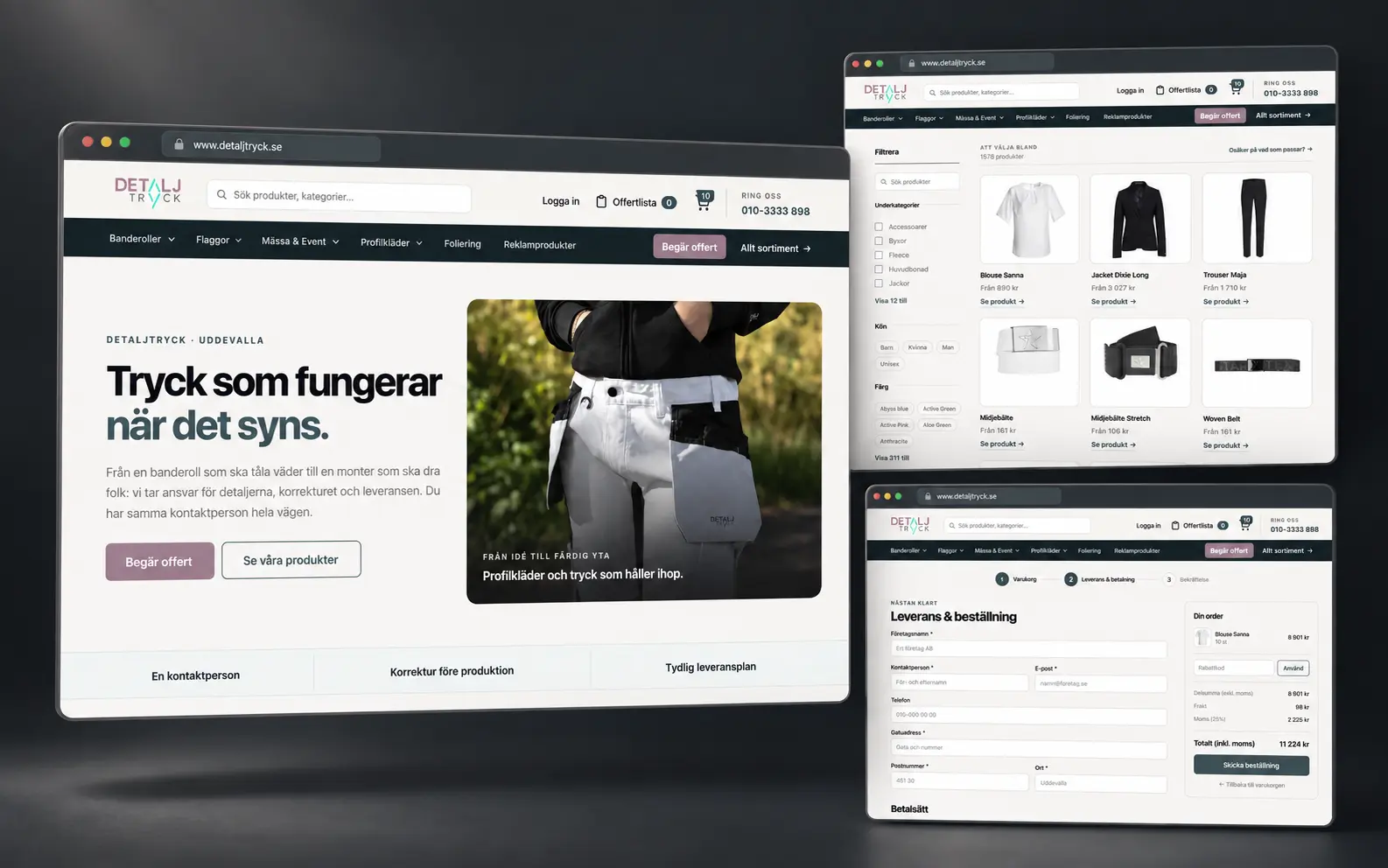
Short answer: A website can be connected directly to a CRM and ERP system so that customer enquiries, products, quotes and administration are handled in one coherent flow. For Detaljtryck, Webbi built such a solution from scratch in Laravel, tailored to the company's own way of working.
Many companies have a website that works as a digital brochure and several separate tools for the work that happens behind the scenes. Customer enquiries come in via forms and email, quotes are created in another program, and information about customers, products and orders is handled in yet other places.
This often works while the business is small and the number of cases is limited. But when the product range grows, more people become involved and every order contains several choices, duplicated work, information gaps and unnecessary administration quickly arise.
That was the starting point when we at Webbi were given the assignment to develop a new digital solution for Detaljtryck. The need was not just about a more modern website. Detaljtryck needed a coherent platform where the customer's way in and the staff's work behind each assignment could meet in the same system.
The project at a glance
- New public website developed in Laravel
- Custom-built CRM and ERP system
- Unified handling of customers, products and enquiries
- Structured quote flows for complex orders
- AI support for selected parts of the administration
- Technical foundation for more integrations and continued automation
Why an ordinary website was not enough
Detaljtryck works with printed matter, promotional products and display solutions. The range includes banners, flags, branded clothing, vinyl wrapping, displays and materials for trade fairs and events.
Unlike a traditional web shop, many orders are hard to reduce to one product, one quantity and a fixed price. The customer may need to choose dimensions, material, printing method, colour, quantity, finishing and delivery time. It may also require a check of the original artwork, personal advice or a special quote before the order can proceed.
An ordinary website could have displayed the products, but it would not have solved the work after the customer sent their enquiry. A standalone CRM system could likewise have stored customer details, but would not automatically understand the context from the website's products and quote flows.
The solution therefore had to cover both the public customer experience and Detaljtryck's internal processes.
What is a coherent digital platform?
A coherent digital platform means that the website and the business system do not work as two isolated solutions. They share structure, information and workflows so that data does not have to be entered more than once.
In Detaljtryck's case, the platform consists of two distinct parts:
The public website
Helps customers understand the product range, compare different solutions and send a relevant enquiry with the right information.
The internal business system
Brings customers, products, enquiries, quotes and administration together in one shared working environment.
What matters is the connection between these parts. The information follows through the process and can be reused instead of being moved manually between web forms, email, spreadsheets and separate business systems.
A clearer path through a complex product range
When a company has a large and varied product range, it is not enough to put all the products in one long list. The website must help the visitor understand which product suits their current need.
That is why Detaljtryck's new website was built with a clear category structure, informative product pages and well-thought-out paths to contact and quote. The customer can start from their need, for example exposure at a trade fair, branded clothing for staff or a banner for outdoor use, and then find the right product category and solution.
The structure does not only help the visitor. It also creates better conditions for SEO and AEO. When every category and product has a clear purpose, descriptive content and concrete answers, it becomes easier for both search engines and AI-based search services to understand what Detaljtryck offers.
A good product structure should help the customer answer:
- Which product suits my use case?
- Which material and format should I choose?
- What information do I need to provide?
- Can the product be ordered directly or is a quote needed?
- What happens after I have sent my enquiry?
CRM and ERP built around the business
A CRM system is usually used to manage customers, contacts, enquiries and follow-up. An ERP system gathers more of the business's operational information, such as products, orders, documents and administrative processes.
For Detaljtryck we built the functions in the same platform and adapted them to the company's actual workflows. Staff thereby get a shared overview of the information belonging to each customer and assignment.
That is an important difference compared with trying to adapt the business to a generic standard system. Printing and branding assignments often contain more variables than a traditional order. The internal system therefore needs to support both simpler product enquiries and more complex projects where specifications and conditions change during the dialogue with the customer.
Read more about how we develop custom-built web systems for Swedish businesses.
When the website and business system share information
The biggest gain does not come from a single feature. It comes from the parts working together.
When a customer sends an enquiry via the website, it can be linked to the right product, category and customer details in the internal system. Staff do not have to start over by manually gathering information from several different sources.
The same principle applies when products and content are managed. A shared data model makes it possible to reuse information and keep the structure more consistent throughout the platform.
A coherent flow can look like this:
- The customer finds the right category or product on the website.
- The customer sends a structured enquiry with relevant details.
- The enquiry becomes available in the business system.
- Staff continue the work with customer dialogue, quote and administration.
- The information remains gathered for follow-up and future orders.
This reduces the risk of information getting lost between different systems and makes it easier to follow an assignment from the first enquiry through to continued handling.
AI as support in daily work
The platform also contains AI-supported functions that can make selected parts of the work more efficient. The focus is not on replacing personal service, but on reducing the time spent on repetitive and administrative tasks.
This is particularly relevant in a business where the customer's needs often need to be interpreted and supplemented before a final proposal can be produced. AI can act as support, but human judgement and dialogue remain where they create the most value.
By building the AI functions as part of the existing platform, they can work with the right context and become a natural part of the workflow. Read more about our AI solutions for businesses.
The result: a digital foundation for the whole business
Detaljtryck now has a coherent digital environment where the public website and the internal business system work together.
For the customer, this means a clearer path through a broad product range and better opportunities to send an enquiry that contains the right information from the start. For staff, it means more structure and control over the work behind each assignment.
The platform reduces the need for separate tools and double administration. At the same time, it is built to be developed further as the business evolves.
What Detaljtryck has gained
- A modern website and an internal system in the same technical environment
- A clearer product and category structure for customers
- More relevant and structured quote requests
- Consolidated handling of customers, products, quotes and administration
- Less need for double entry and separate tools
- A stable foundation for new integrations and more automation
See the full case study: Detaljtryck: a coherent digital platform.
When does a custom-built digital platform make sense?
Not every company needs a purpose-built CRM or ERP system. For many businesses, an ordinary website together with an established standard system is enough.
A custom-built solution becomes relevant above all when the business's ways of working, products or customer flows are too specific for off-the-shelf tools.
It may be time to look into your own platform if:
- customer information has to be entered in several different systems
- quotes are built manually from information in email and spreadsheets
- staff use separate tools that do not communicate with each other
- the website's forms do not collect the right information
- products or services have many options and complex pricing
- the business wants to automate processes that are unique to the company
- current systems limit continued growth
What matters is not how many features the system has. What matters is whether the solution simplifies the work, creates better control and makes it possible to handle more customers without the administration growing at the same pace.
Frequently asked questions about websites, CRM and ERP
Can a website be connected directly to a CRM system?
Yes. Forms, customer accounts, product selections and quote requests can be sent directly to a CRM system. This reduces manual entry and makes it easier to follow the customer from first contact to completed assignment.
What is the difference between CRM and ERP?
CRM focuses mainly on customers, sales, enquiries and follow-up. ERP is used to manage broader processes in the business, such as products, orders, finance and administration. In a custom-built platform, functions from both systems can be combined.
Do you have to replace all existing systems?
No. A new platform can often be integrated with existing accounting, payment, inventory or communication systems. Which parts should be kept or replaced is decided after a review of the business's needs.
Why build a business system in Laravel?
Laravel is well suited to custom-built business systems because it provides a stable foundation for user roles, databases, integrations, administration and complex business logic. The platform can also be developed further when the business has new needs.
Can AI be integrated into a CRM or ERP system?
Yes. AI can be used, among other things, to structure information, summarise material, suggest next steps and make repetitive tasks more efficient. The greatest benefit arises when the AI function is integrated into the company's existing workflow.
How do we know if we need a custom-built system?
A common sign is that employees have to move information between several tools, create quotes manually or adapt their way of working to systems that do not suit the business. A needs analysis can show whether the problem should be solved with integrations, a standard system or a custom-built platform.
Have you also outgrown your current tools?
We help companies connect websites, customer flows and internal processes, from needs analysis and requirements specification to a finished technical solution.
Tell us about your needs