Examples of Web Systems for Swedish Businesses: From Service to Marketplace

- Web systems can replace Excel sheets, email chains and manual processes that cost time every day
- Common types are CRM, case management, customer portals, booking systems and internal tools
- The right system saves hours every week, for you and your colleagues
- Many systems can be delivered as an MVP within just a few weeks
- The system does not need to be complex to make a big difference
1. Overview: common types of web systems
Before we get into industry-specific examples, here is a quick overview of the most common system types and what they solve:
| System type | What it solves | Suited for |
|---|---|---|
| Case management systems | Replace email chains and Excel for following up jobs and cases | Service, support, maintenance |
| CRM systems | Bring customer data, leads, quotes and follow-up together in one place | Sales teams, consultancies, agencies |
| Customer portal | Gives customers logged-in access to their status, documents and communication | B2B services, law, accounting |
| Booking systems | Automate booking, confirmations, reminders and payment | Clinics, gyms, consultants, venues |
| Order management systems | Connect webshop, inventory and delivery in one flow | E-commerce, wholesalers, manufacturers |
| Internal tool / dashboard | Gathers data from several sources for decision support and reporting | All industries with data-driven decisions |
| Marketplace / SaaS platform | Connects several parties: buyers, sellers, suppliers | Startups, platform companies |
2. Service companies: case management and customer portal
Service companies, such as tradespeople, repair workshops and technical support firms, often handle dozens or hundreds of active cases at the same time. Without a system it is easy to lose track, forget follow-ups and spend unnecessary time answering status questions.
Phonet Core is a system we built for mobile phone repair and the trade in second-hand phones. The system handles the whole flow from drop-off and diagnosis to repair, pricing and hand-over. Customers can follow their case in real time through a customer portal, and the workshop no longer has to answer status questions by phone.
What it replaced: Paper slips, Excel sheets and manual communication by SMS and email.
The result: Faster throughput, fewer misunderstandings and a customer experience that builds trust.
Similar systems suit: plumbing firms, car workshops, IT support, cleaning companies, property managers, and anyone who handles recurring jobs with several steps and several parties involved.
3. Sales organisations: CRM and pipeline
Sales teams without a CRM system lose leads, drop follow-ups and find it hard to analyse what works. Off-the-shelf tools such as HubSpot and Salesforce solve part of the problem, but they are often too generic, too expensive per user, or lack integration with the specific processes a company has.
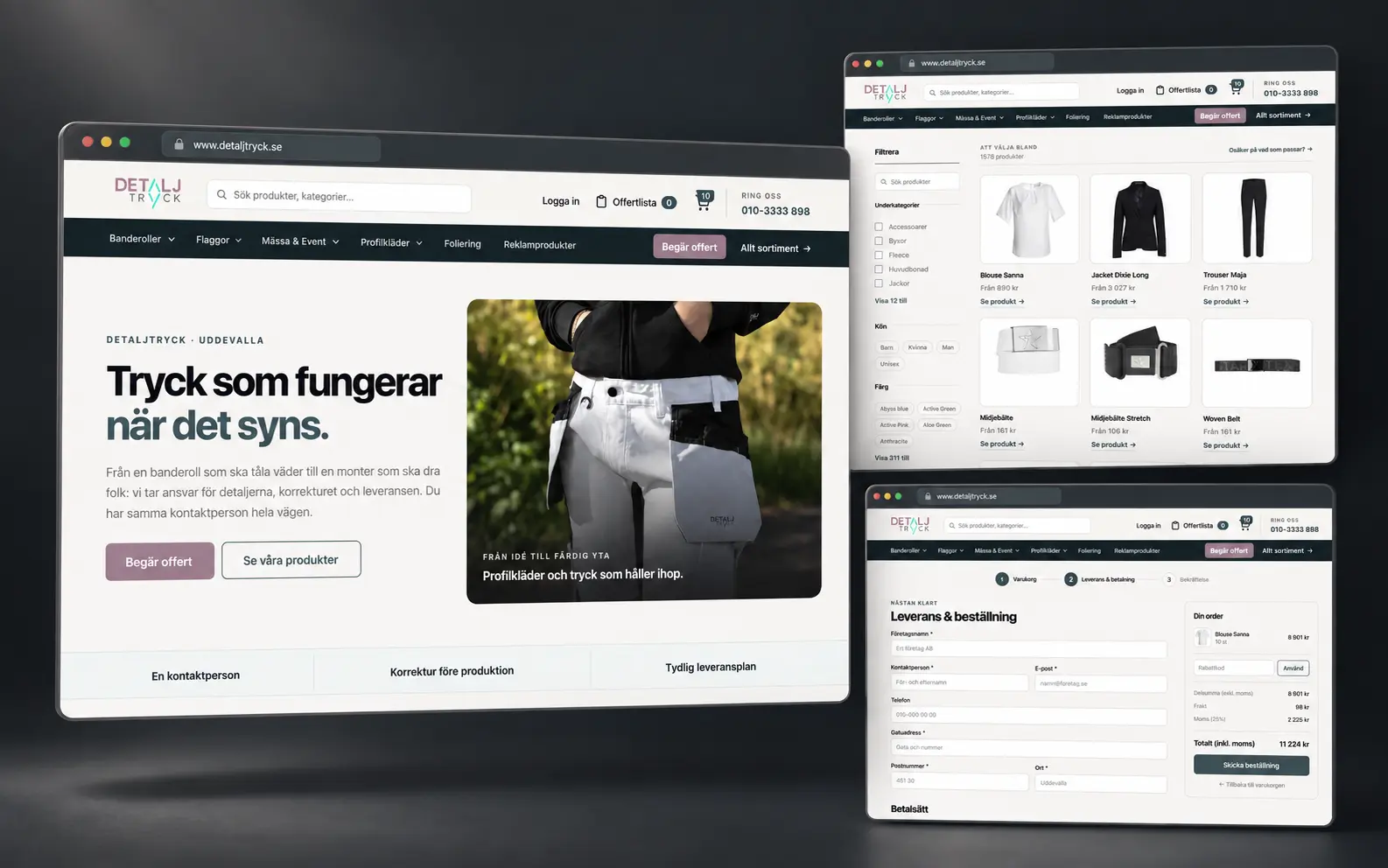
For Detaljtryck Sverige AB we produced the specification for a bespoke CRM that handles the entire sales process, from incoming enquiry and costing to quote, order confirmation and invoicing. The system is built to fit the specific needs of the printing industry and can in time grow into a SaaS product for similar companies.
What it replaces: Quotes in Word, orders in email, follow-up in Excel.
Why bespoke: The printing industry has complex calculations involving paper type, format, print run and finish, and no off-the-shelf CRM handles that well.
Similar systems suit: consultancies, agencies, installers, manufacturers, and anyone with a sales process involving quotes, approvals and returning customers.
4. E-commerce and logistics: orders and inventory control
A webshop is only one part of e-commerce. What happens after the customer clicks buy (picking, packing, inventory management, returns, delivery notifications) is often a patchwork of systems that do not talk to each other. A bespoke order management system ties the whole flow together.
CarOnSpot is a complete Laravel-based marketplace for car rental with a multi-tenant architecture. The platform handles multiple rental providers, booking flows, payment, availability calendars and an admin panel for each rental partner. The end customer books and pays directly, without us having to be involved manually at any step.
What it enables: A scalable platform business where the number of rental partners can grow without operating costs growing proportionally.
Similar systems suit: wholesalers with reseller networks, rental companies, logistics firms, and importers with complex order flows.
5. Healthcare and wellbeing: booking and patient management
In healthcare and wellbeing, manual booking and paper-based record keeping are not only inefficient, they also create risks. A digital booking and patient management system saves time for staff and gives patients a more reassuring experience.
A typical solution for a private clinic or practice includes: online booking with an availability calendar per practitioner, automatic confirmations and SMS reminders, a secure logged-in patient portal, record notes with permission control, and payment via Stripe or Klarna.
What it replaces: Phone bookings, manual reminders, paper forms and Excel-based scheduling.
GDPR note: Systems that handle patient data require special care around storage, encryption and access control, which we always include in the requirements specification from the start.
Similar systems suit: dental practices, physiotherapists, psychologists, beauty clinics, gyms and personal trainers.
6. Construction and property: project tracking
Construction projects involve many parties (clients, project managers, subcontractors, suppliers) and require ongoing follow-up of time, costs, change and additional work orders (ÄTA) and documentation. Without a shared system it is easy to lose control.
A project tracking system for a construction company gathers all active projects in one place: time logging per project and person, budget versus actuals, document management with version history, ÄTA management with approval flows, and a portal where the client can follow status without having to call the project manager.
What it replaces: Time reporting in Excel, email chains with PDF attachments, manual budget follow-up and status meetings that could have been avoided.
Similar systems suit: electrical and plumbing installers, property managers, architecture firms, and consultancies with project-based invoicing.
7. Education and courses: course platform and LMS
Training companies and course providers who want to digitise their offering often need more than a video tool. A bespoke LMS (Learning Management System) handles course content, participant registration, progress, certificates and payment in one and the same system.
A course platform we typically build includes: a course catalogue with search filters and categories, participant registration and paid access via Stripe, video content with progress tracking, quizzes and knowledge tests, automatic certificate generation when a course is passed, and an admin panel for course managers.
What it replaces: Manual registration, PDF certificates sent by email, Zoom recordings that cannot be searched, and Excel sheets for tracking participants.
Similar systems suit: trade associations with mandatory training, consultancies that sell knowledge products, and HR departments with internal skills development.
8. Marketplaces and platforms
A marketplace is the most complex type of system to build, but also the one with the greatest potential to scale. The basic idea is that the platform connects two or more parties and handles the transaction between them.
| Type of marketplace | Example | Core technology |
|---|---|---|
| Service marketplace | Tradespeople meet private customers | Multi-tenant, reviews, escrow payment |
| Rental platform | Cars, premises, equipment | Availability calendar, booking flow |
| B2B marketplace | Wholesalers meet resellers | Customer-specific price lists, order management |
| Care marketplace | Healthcare and care staff meet families | Matching, background checks, booking |
9. Do you recognise your need?
Regardless of industry, the need for a web system tends to show up in the same way. You probably recognise at least one of these:
- You or your team spend time answering status questions that a system should be able to answer automatically
- Important information lives in email threads, chat messages and Excel files instead of one central place
- You have tried an off-the-shelf SaaS tool, but it does not quite fit the way you work
- You are growing, and the tools you use today do not scale with the business
- You are losing revenue or customers because processes are too slow or error-prone
- You need to give customers or partners access to information without involving your staff every time
If you tell us about your situation, we will carry out a free needs analysis and explain what a system in your situation would cost and how long it would take to build.
Book a free consultation