What is a web system, and does your company need one?
You have probably heard the word web system, but what is it really, and how does it differ from an ordinary website? In this article we explain what a web system is, which problems it solves and how we at Webbi work together with clients to build systems that actually make a difference in everyday work.
1. What is a web system?
A web system is an application that runs in the browser and handles specific business processes, unlike a website, whose primary purpose is to present information. Web systems are built to do something: manage cases, automate workflows, store data, communicate with other systems or give users access to tailored functionality.
Put simply: a website tells people who you are. A web system helps you run your business.
2. The difference from an ordinary website
It is easy to mix up the terms. Here is the practical difference:
Website
Presents your company, your services and your contact details. The visitor reads and gets in touch. Content is updated manually via a CMS.
Web system
Handles processes and data. The user logs in, performs actions and submits information, and the system responds, automatically and in real time.
CMS (content management)
A system for creating, editing and publishing content without technical knowledge. WordPress is the most common example.
CRM (customer management)
A system for managing customer relationships, leads, quotes and communication. It can be custom-built or based on an existing platform.
In practice, a solution can contain several of these parts at once: a website with a built-in booking system and a customer portal is both a website and a web system.
3. Concrete examples of web systems
Web systems look very different depending on the industry and the need. Here are some common types we build:
Case management systems
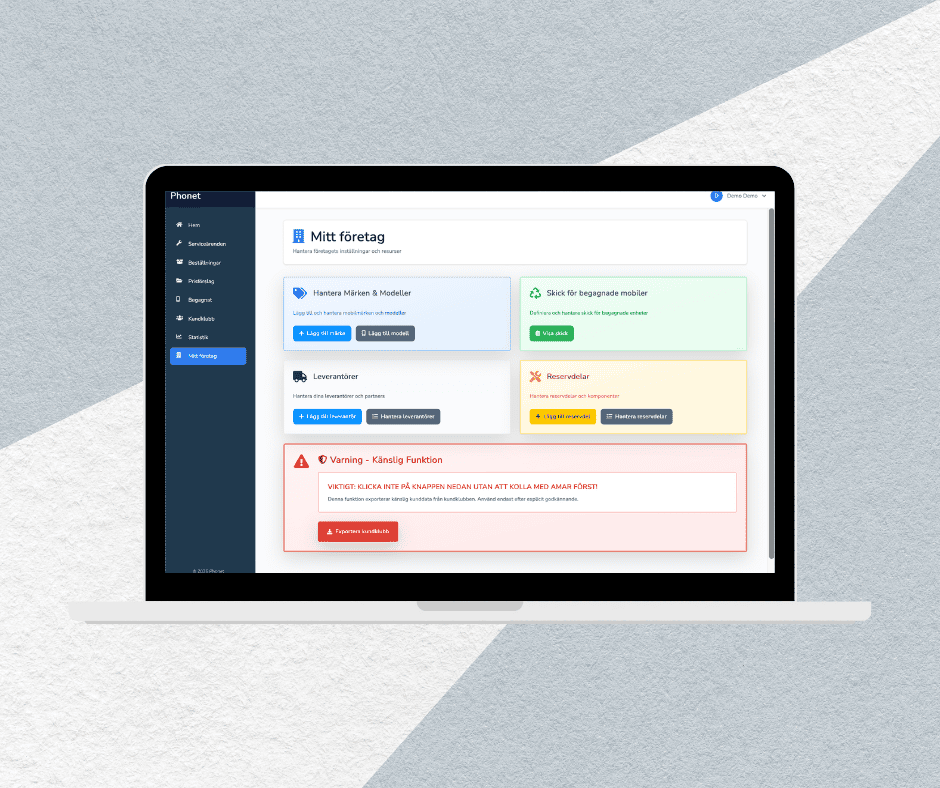
Replace email chains and Excel sheets for following up cases, service jobs or customer enquiries. All parties see the status in real time and nothing falls through the cracks. An example from our portfolio is Phonet Core – a custom-built case management system for mobile phone repair and second-hand phone trading.
Customer portals
Give your customers a logged-in view where they can follow their orders, download documents, approve quotes or communicate with you directly, without requiring manual handling on your side.
Booking and scheduling systems
Automate the booking of time, resources or staff. The customer books on their own via the web and the system handles confirmations, reminders and calendar management.
Custom-built CRM systems
Handle the entire customer journey, from first contact and quote to order, invoice and follow-up, tailored exactly to how your company sells and follows up.
Marketplaces and platforms
More complex systems where several parties interact, such as CarOnSpot, a Laravel-based marketplace for car rental with a multi-tenant architecture that we built from scratch.
Internal tools and reporting systems
Dashboards, report generators and administrative tools that collect data from several sources and present it in a way that saves your staff time.
4. When does your company need a web system?
You probably need a web system if you recognise yourself in any of the following:
- You or your colleagues spend a lot of time on manual, repetitive tasks that ought to be automatable
- Important information is scattered across email chains, Excel sheets and chat messages instead of a central system
- Your customers often ask about the status of their orders, cases or deliveries
- You find it hard to get an overall picture of your business: what is in progress, what is done and what has got stuck
- You are growing and your current tools do not scale with the business
- You have tried off-the-shelf SaaS solutions but they do not quite fit how your company works
5. How we at Webbi work with web systems
We do not build systems and hope they fit. We work closely with the client throughout the project, from the first requirements analysis to launch and ongoing support. This is what our process looks like:
-
1
Needs analysis and requirements specification
We always start by understanding the business. What is the problem today? Which processes should the system handle? Who will use it, and how? The result is a clear requirements specification that we both sign. Nothing is built without you knowing exactly what you are buying.
-
2
Design and prototype
Before we write a single line of code, we create wireframes and clickable prototypes. You see how the system will look and work, and can give feedback early, while it is still easy to change.
-
3
Development in iterations
We work in short sprints and deliver partial functionality continuously. This means you can test and give feedback during the project, not just when everything is finished. No nasty surprises at final delivery.
-
4
Regular meetings and check-ins
We hold regular status meetings during the project. You always know where we are, what is done and what the next step is. No long periods of silence and no guessing.
-
5
Testing and quality review
Before launch we test the system thoroughly: functionality, performance, security and usability. We do not deliver anything we are not satisfied with ourselves.
-
6
Training and documentation
You and your colleagues should feel confident with the system from day one. We hold walkthroughs, answer questions and deliver documentation that makes it easy to onboard new users.
-
7
Support and further development
We do not disappear after launch. With a support agreement you have access to priority help when problems arise, ongoing updates and the opportunity to keep building on the system as the business grows.
What we offer
We build custom-built web systems for Swedish businesses, with transparent pricing, code you own and support that is actually there when you need it.
- Custom-built CRM systems tailored to your sales process
- Case management and customer portals
- Booking and scheduling systems
- Marketplaces and SaaS platforms
- Internal tools, dashboards and reporting systems
- Integrations with existing business systems and APIs
- Ongoing support, training and further development
6. Technology and platforms we use
We always choose technology based on the needs of the project, not on what is trendiest right now. Here are the platforms and frameworks we work with:
Laravel
Our primary framework for custom-built web systems. Robust, scalable and with strong security built in from the ground up.
Livewire & Alpine.js
Provide dynamic, reactive functionality without building a separate front-end application. Faster to develop and easier to maintain.
MySQL & PostgreSQL
Proven database solutions for secure and efficient storage of business-critical data.
REST API & integrations
We connect the system to external services: payment solutions, email, SMS, booking systems and more.
AI integrations
We build in AI functionality where it adds real value: document analysis, automation, chatbots and GPT integrations.
Security & GDPR
Role-based access control, encrypted data, secure forms and GDPR-compliant handling of personal data, always built in from the start.